Why real GTINs matter
Why You Need Real GS1 GTINs - and What Happens If You Don't
The Risks of Skipping Proper Registration for Your Produce Business
If you're a produce shipper setting up traceability for the first time, you might be wondering: do I really need to pay for official GS1 GTINs? Can't I just make up my own product numbers and track everything with lot codes?
It's a fair question. After all, if your internal system can trace a pallet back to the field it came from, what difference does the number on the label make?
Turns out - a big difference. Here's why cutting corners on GTINs can cost you a lot more than the registration fee.
📋 Quick Refresher: What's a GTIN?
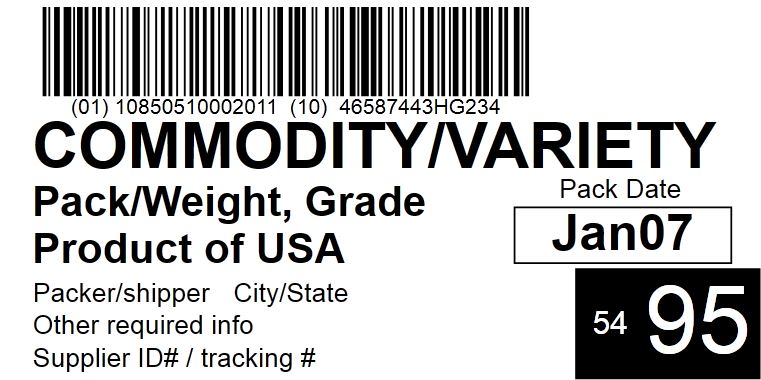
A GTIN (Global Trade Item Number) is a unique product identifier issued by GS1, the organization that manages barcode standards worldwide. It's the number inside every UPC and GS1-128 barcode, and it tells everyone in the supply chain exactly what a product is and who it belongs to. Think of it as your product's passport - it's recognized everywhere, by every system, at every step of the chain.
The Temptation: "Can't I Just Make Up a Number?"
We get it. GS1 registration costs money, takes a few steps, and if you already have a system that tracks lot codes and pallets internally, it can feel like an unnecessary expense. If your own traceability platform knows that lot code 2024-0415-ROMA belongs to Roma Tomatoes harvested from Field 3 on April 15th, who cares what number is on the barcode?
The problem is that your system isn't the only system that needs to read that number. The moment your product leaves your dock and enters a buyer's warehouse, distribution center, or retail store, it enters a world of interconnected systems that all speak the same language - GS1.
Here's what can go wrong when you skip the official registration.
⚠️ The Real Risks of Using Unregistered Numbers
Retailers Will Reject Your Shipments
This is the biggest and most immediate risk. Major retailers like Walmart, Kroger, Costco, and large foodservice distributors verify GTINs against the GS1 database. If your number doesn't check out, they can hold or flat-out reject the entire shipment - and charge you penalties on top of it. Your client eats the cost of relabeling, repackaging, and delayed delivery. When you're shipping fresh produce that's already on a clock, a rejected load isn't just expensive - it can be a total loss.
You'll Run Into Trouble with FSMA 204
The FDA's FSMA Section 204 food traceability rule is the biggest regulatory change to hit produce in years. While the FDA doesn't technically mandate GS1 standards by name, the entire framework is built around standardized, interoperable identification across every link in the supply chain. Made-up numbers work inside your own system, but the moment the FDA or a buyer's system needs to trace a product during a recall, non-standard numbers create gaps. And in a recall situation, gaps mean liability.
PTI Compliance Goes Out the Window
The Produce Traceability Initiative (PTI) requires GS1-128 barcodes with valid GTINs on every case. While PTI is technically a voluntary industry initiative, individual retailers make it mandatory as a condition of doing business with them. Walmart, for example, requires all fresh produce shipped to their distribution centers to show a standardized PTI-compliant case label. No valid GTIN, no compliant label. No compliant label, no sale.
Number Collisions Can Cause Chaos
This is the sneaky risk that people don't think about. If you generate a number that happens to match someone else's legitimate GTIN, it causes havoc in receiving systems. Shipments get misrouted, inventory counts break, and the buyer's warehouse management system thinks your Roma Tomatoes are someone else's laundry detergent. GS1's entire purpose is to guarantee that no two products in the world share the same number. When you make up your own, you have zero guarantee of uniqueness.
You Look Unprofessional to Buyers
Buyers and category managers at major retailers and distributors deal with hundreds of vendors. When they scan your case and get an unrecognized GTIN - or worse, a number that belongs to someone else - it raises immediate red flags. It signals that your operation may not be up to the standards they expect. In a competitive market where shelf space and distribution contracts are hard to win, that kind of first impression can cost you the relationship.
"But My Lot Codes Already Track Everything..."
You're right that lot codes are powerful. They tell you which field the product came from, when it was harvested, which crew packed it, and which pallet it ended up on. That's essential for internal traceability and for responding to food safety issues quickly.
But lot codes and GTINs answer different questions:
📦 Lot Code
"Which specific batch is this?"
Tracks the when, where, and how of a specific production run. Essential for recalls and internal quality control. Works great inside your own system.
🌐 GTIN
"What is this product and who made it?"
Identifies the product universally across every system in the supply chain. Recognized by retailers, distributors, the FDA, and every trading partner worldwide.
Lot codes without a valid GTIN are like having a detailed street address but no city or state. Your system knows exactly what it means, but nobody else's does. You need both working together for complete, end-to-end traceability.
🚫 What About Cheap Barcodes from Third-Party Resellers?
You might see websites selling "UPC codes" for a few dollars each. These are typically recycled or unauthorized numbers originally registered to someone else. The risks are the same - or worse - than making up your own:
The Bottom Line
Inside your own traceability system, made-up numbers technically work. But the moment your product leaves your dock and enters someone else's system - a distribution center, a retail store, an FDA inspection - non-GS1 numbers become a liability.
For a starting cost of $250 to $750, a proper GS1 Company Prefix gives you legitimate, globally unique GTINs that are recognized by every retailer, every buyer, and every regulatory system in the world. Compared to the cost of a single rejected shipment of fresh produce - or worse, the cost of not being able to trace product during a recall - it's one of the easiest investments you'll make.
Don't Want to Deal with the Paperwork?
AgTagUSA can handle the entire GS1 registration process for you - from creating your account to assigning GTINs and setting up your products. We'll get you compliant and ready to ship in just a few days.
Check out our step-by-step GS1 registration guide or reach out to get started.
Contact Our Team